The Basics
What is an absence seizure?
A brief, sudden episode of impaired awareness caused by abnormal electrical activity that begins simultaneously on both sides of the brain.
Overview
An absence seizure is a brief, sudden episode of impaired awareness caused by abnormal electrical activity that begins simultaneously on both sides of the brain (a generalised onset seizure).
During a typical absence seizure, the person (usually a child) suddenly stops what they are doing, stares blankly, and may show subtle signs such as eyelid fluttering or slight upward eye movement. The seizure usually lasts less than 10–20 seconds and ends abruptly, with the person returning to normal activity almost immediately and often unaware that anything happened.
These seizures can occur many times a day and are frequently mistaken for daydreaming or inattention.
The best way to visualise a generalised onset seizure is with an EEG. An EEG is a test that places small electrodes on the scalp to measure and record the brain's electrical activity across different regions.
A Real Recording
An EEG readout of an absence seizure
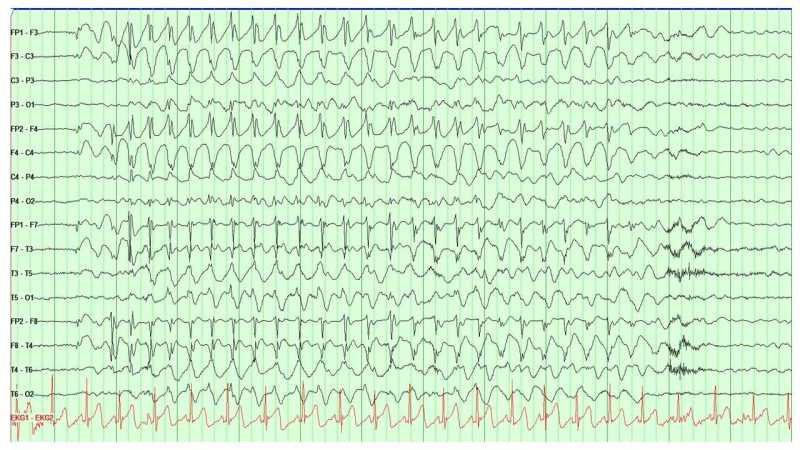
Below is a real EEG (electroencephalogram) readout of an absence seizure, followed by a clear description of what you are seeing.
EEG Description
This EEG shows a generalized spike-and-wave discharge lasting approximately 9 seconds. Each horizontal line represents a recording channel created by a pair of electrodes placed on the scalp. Because the high-amplitude rhythmic activity appears simultaneously on nearly every channel (both left and right sides, and from front to back), the discharge is generalized — it involves both hemispheres and is widespread across the brain.
The vertical red lines mark successive 1-second intervals. Within the discharge the complexes occur regularly at a rate of three per second (3 Hz). A 3 Hz generalized spike-and-wave pattern of this type is the electrographic hallmark of typical absence seizures.
The recording returns to a lower-amplitude mixed-frequency background after the discharge ends. The simultaneous EKG channel remains regular throughout.
For Context
- In absence epilepsy beginning in adolescence the discharges are often slightly faster and less regular (commonly 3–5.5 Hz) and may contain polyspike components.
- Slow spike-and-wave activity (< 2.5 Hz) is more characteristic of atypical absences.
The Science, Simply
How to think about a seizure
A typical brain
Activity is localized. Many small groups of neurons fire in short, independent bursts, sending signals along specific pathways — like scattered forks of lightning, each staying within its own confined area. This keeps brain function organized and stable.
During an absence seizure
A circuit linking the thalamus and cerebral cortex suddenly locks into a highly synchronized rhythm, around three cycles per second. Large numbers of neurons fire together in brief, coordinated bursts — more like sheet lightning spreading across the sky.
During an absence seizure, a circuit linking the thalamus (a deep relay station involved in alertness and sensory processing) and the cerebral cortex (the outer layer responsible for awareness) suddenly locks into a highly synchronized rhythm, typically around three cycles per second. This widespread electrical pattern briefly overrides normal brain function, causing the child to stare blankly for a few seconds.
The seizure is self-limiting. After the synchronized activity runs its course, the brain's built-in regulatory systems restore normal function. Neurons use intrinsic mechanisms, including potassium channels, to return their electrical charge to a stable resting state. Inhibitory signalling, particularly involving the neurotransmitter GABA, also plays an important role — both in shaping the oscillatory pattern and in helping to dampen and eventually stop the excessive synchrony. Together, these processes allow the brain's electrical activity to return to its normal, independent, and stable state.
Further Reading